


Logistics
The cold chain is ours, not a courier's
From the moment seafood is harvested, Divron controls its journey. Our own vehicles, trained drivers, live-transport systems, chilled vehicles and cold storage move the catch from communities across Sri Lanka while protecting its condition, temperature and quality.
Harvest to airport
Every leg on our own equipment
01
Harvest
At the community
02
Collection
Our vehicle, our driver
03
Factory
Negombo
04
Quality control
Before it is accepted
05
Packing
To the order
06
Airport
And out
Why we own it
The weakest hour decides what the harvest is worth.
Quality can be lost in a few hours if transport is not properly controlled, and those are the hours a third-party carrier has the least reason to care about. So we do not sub-contract them. Divron runs its logistics network so the cold chain stays under our control rather than being handed to an outside transporter, built alongside the fisher supply chain in partnership with the Market Development Facility and Australian Aid.
That is the difference between a supplier who can describe the cold chain and one who can be held to it. We design our logistics around protecting the product during that weakest hour, and nothing changes hands until the buyer's forwarder takes it.
It is also the least wasteful way to run it. A consignment that arrives in the condition it left in is one nobody has to write off, and cutting that loss is the most concrete thing a cold chain contributes to sustainability.
Our logistics system
- Vehicles
- Owned and controlled by Divron
- Refrigeration
- Built into the vehicle body
- Crates
- Insulated seafood crates
- Storage
- Our own cold store
- Drivers
- Trained, and ours
- Routes
- Planned collection runs
- Handling
- Controlled at every transfer
- Receiving
- Factory intake and quality control
Live, fresh-chilled and cryogenic are the three ways a batch leaves us, and grading commits it to one before it goes. What each of them arrives as is set out on the product page.
See the three formatsFrom the community
Our vehicles go to the catch, not the other way round.
Our supply begins across coastal and inland communities. Our vehicles travel directly to the collection points, working with fishermen and community producers to take in seafood as close to the source as possible.
That closeness is the whole point. Because our collection centres sit among the communities we buy from, the catch is received, iced and moving while it is still at its best, instead of waiting on the shore for a carrier to arrive from somewhere else.
collection-point-handover
A Divron driver taking seafood from fishermen at a community collection point
4/3
loading-the-vehicle
Insulated crates being loaded into a Divron vehicle before it leaves the collection point
4/3
Transport
Two ways it travels, both on our own vehicles.
live-transport-tanks
Oxygenated live-transport tanks mounted on a Divron vehicle
4/3
Live seafood transport
Live seafood needs more than refrigeration, so the route is built around it: held and acclimated before the run, oxygenated on the road, and checked at Negombo before it goes on. How that is managed for the animal is stage 03 of the process.
- Collection
- Live holding and acclimation
- Oxygenated transport
- Negombo facility
- Quality check
- Customer or export
chilled-handling-at-the-shore
Fresh seafood being packed into chilled insulated crates for the run to the facility
4/3
Fresh seafood transport
Fresh seafood moves through the same network on controlled handling and chilled transport. The objective is simple: less time, less temperature movement, and the quality it was landed with.
- Harvest
- Chilled handling
- Divron vehicle
- Factory
Temperature
Read, written down, and read again.
A refrigerated vehicle is only worth what it is measured at. Temperature is checked at four fixed points on every run, and each reading is written onto the consignment's run sheet against the driver, the vehicle and the time, so a consignment arrives with a record rather than an assurance.
It is a manual discipline rather than an automatic one. The readings are taken and recorded by the person handling the box, not streamed off a sensor, and the tracking system on this page reports position rather than temperature. We would rather describe what we actually do than claim a feed we do not run.
temperature-check-at-loading
A Divron driver reading a probe thermometer and recording the temperature on a run sheet at loading
4/3
Before loading
The vehicle is pulled down to temperature and read empty, before a single crate goes in.
At the collection point
The catch is read as it is packed into insulated crates on ice at the waterside.
On the run
The driver reads and records the box temperature at each stop between the community and the facility.
At factory receiving
Every consignment is read again at the gate, and quality control accepts or rejects it on what the reading says.
Holding temperatures
- Chilled
- −5 °C to +5 °C
- Cryogenic
- −18 °C to −20 °C
Tracking
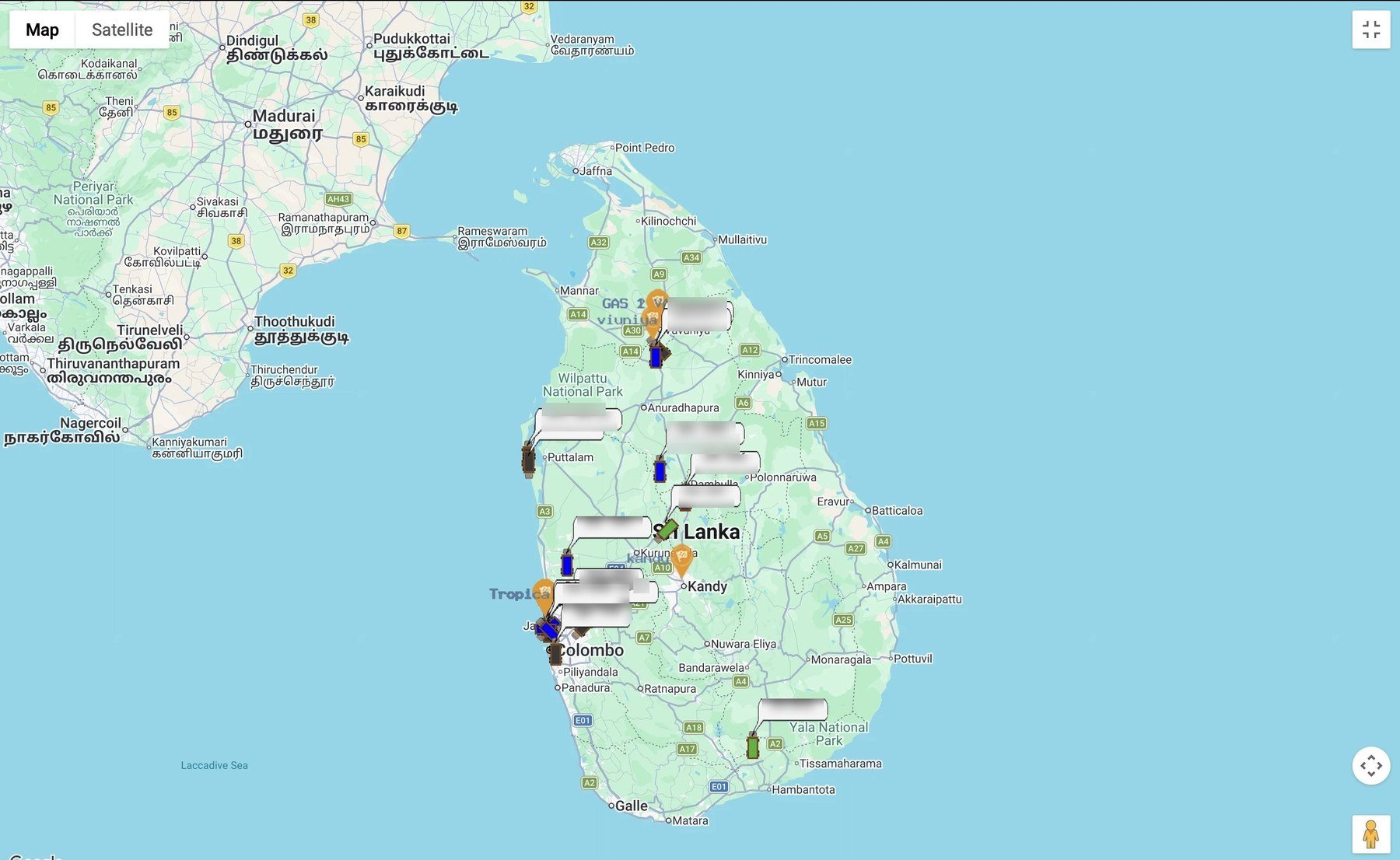
Every vehicle on one screen, all the time
Each vehicle in the fleet carries a GPS unit reporting to a single live map, so at any moment we can say where a consignment is rather than when it was last seen. On an average day that map runs from the northern collection area to the far south of the island.
For a buyer this is the practical end of the traceability claim. The batch on your paperwork traces back through the box it was graded in, the vehicle that carried it and the shore it was landed on. Ask at any point in transit and you get a position, not an estimate.
Consolidation
Every road leads to Negombo.
Product collected across the regions is consolidated at our Negombo facility. At receiving it is taken in, identified, weighed, quality checked and sorted, then processed or held and packed according to the requirement it is going out against.
negombo-facility-receiving
The receiving area at Divron's Negombo facility, with a vehicle unloading
3/2
Collection routes converging on the Negombo facility
- Northern Province
- Eastern Province
- North Western Province
- Inland reservoirs
- Southern Province
- Negombo facility
Factory handover
What happens when the vehicle arrives.
When vehicles reach the Negombo facility the product is handed to the factory team, and every step of that handover is somebody's job rather than a stage in a diagram.
01
Arrival
The vehicle reaches the facility and its consignment is booked in.
02
Handover
Product is transferred from the driver to the factory team.
03
Quality control
Condition, temperature and quality are checked before anything is accepted.
04
Processing
The batch is prepared according to the requirement it is going out against.
05
Packing
Packed for domestic or export requirements, and marked for its route.
To the airport
The last leg is ours too.
Once product is packed and cleared for dispatch, our logistics team coordinates transport from the Negombo facility to the airport. From the point of harvest to the point of export, every movement is planned around one objective: protecting the quality of the product.
- Factory
- Final quality control
- Export packing
- Chilled transport
- Airport
- International destination
export-cartons-ready
Finished export cartons stacked and marked, ready to leave the factory
4/3
airport-cargo-handover
Divron's cargo handover at the airport freight terminal
4/3
Distance
Book our vehicles, or book yours in.
The vehicles on this page cover Sri Lanka every working day, and they can be booked for other cargo. Servicing runs the other way: outside vehicles come in, so you can put your own lorry through it. Send either job to distance.lk and a quote comes back.
Book through distance.lk- Coverage
- The length of the island
- Booking
- Through distance.lk
- Servicing
- Outside vehicles taken in
- Pricing
- Quoted per job
We don't just move seafood. We protect its journey.
Tell us the destination, the format and how fast it has to be there. We will tell you which route it takes and what the chain looks like end to end.